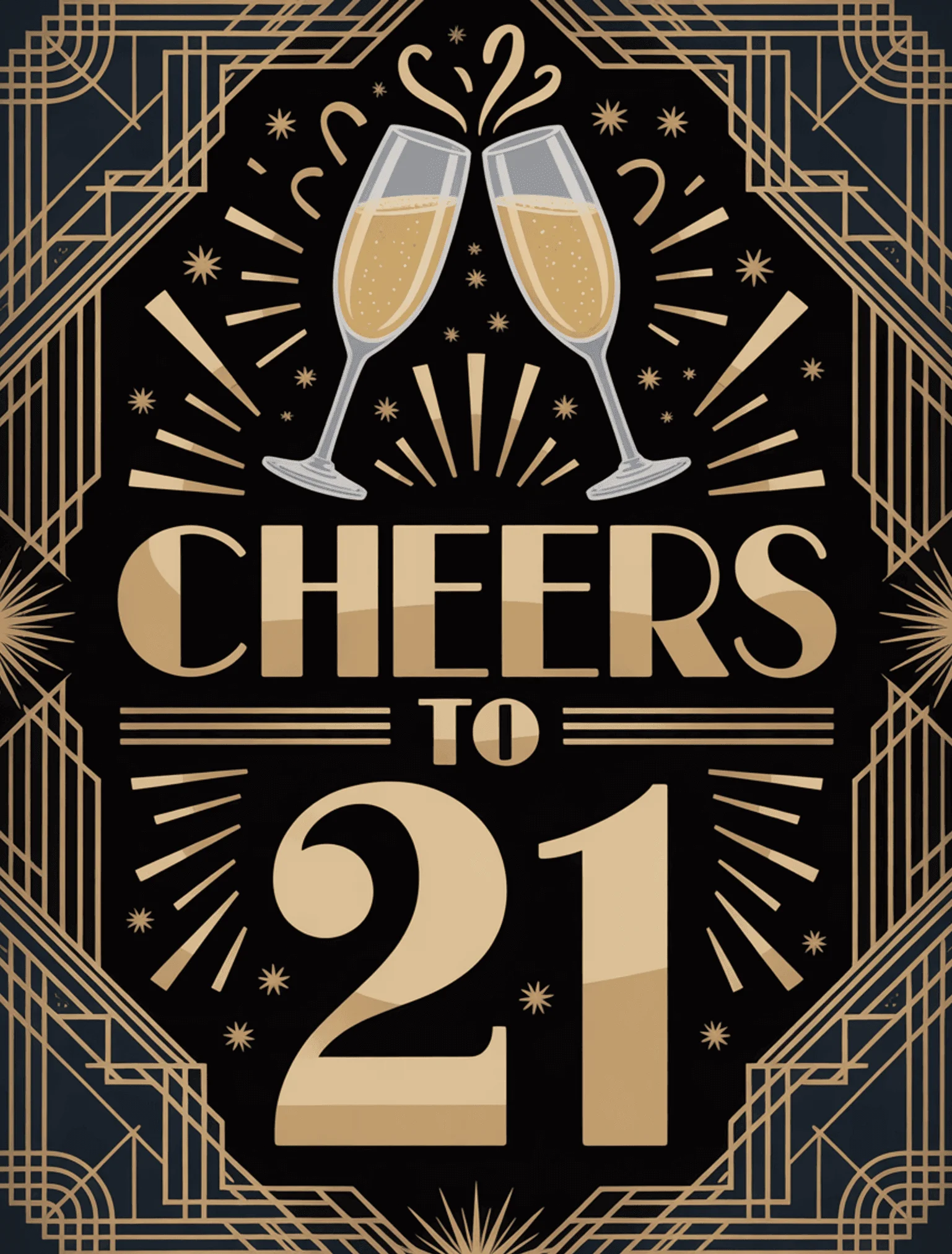
When to Send a 21st Birthday Card
Timing a birthday card is more consequential than most people realize, especially for a milestone like a 21st. The gold standard is arrival on the actual birthday, not the day before, not three days after. For a mailed card, that means dropping it in the mail five to seven business days before the birthday if you're sending within the continental U.S. If you're cutting it close, consider whether a same-day or next-day delivery service is worth the cost, because a card that arrives a week late reads as an afterthought, regardless of how thoughtful the message inside is.
For a 21st specifically, there's a secondary timing consideration: many people celebrate over an extended weekend or even a full week of events. If you know the recipient is having a big party on a Saturday, aim for the card to arrive by Friday at the latest so they can read it before the festivities rather than after. That small detail signals that you planned ahead and that the card is part of the celebration, not a footnote.
If you genuinely missed the date, send the card anyway, but acknowledge it briefly inside. A one-sentence nod to the lateness ('I know this is arriving after the fact, but I didn't want to let the moment pass without saying something real') is far better than pretending it arrived on time or, worse, not sending anything at all.
What Tone to Strike for a 21st Birthday
The instinct most people follow is to go funny. That's not wrong, but funny is the hardest tone to execute in writing, especially in a short card message. A joke that lands in person can fall completely flat on paper, where there's no facial expression or vocal delivery to carry it. Unless you are genuinely funny in your written communication with this person on a regular basis, lean toward warm and sincere rather than trying to make them laugh.
The second instinct people have is to go sentimental, to reach for the big emotions of watching someone grow up, the passage of time, pride in who they've become. This tone works, but it has a ceiling. It's most appropriate from parents, grandparents, or people who have known the recipient since childhood. From a college friend, a coworker, or a cousin you see twice a year, heavy sentiment can feel disproportionate and even a little uncomfortable to receive.
The most versatile tone for a 21st birthday card is **warm specificity**: say something true and particular about this person, acknowledge what the milestone actually means, and close with something forward-looking. Specific always beats generic. 'You've always known exactly what you want and gone after it' lands harder than 'You're going to do great things.' The former is a real observation; the latter is filler.
How to Structure Your Message
A greeting card message has a natural three-part structure, even if it's only three sentences long. Open with an acknowledgment of the occasion that goes one layer deeper than just naming it. The middle does the real work, it's where you say the thing that makes this card about *this person* rather than any 21-year-old. The close lands the emotional note you want to leave them with, whether that's warmth, humor, excitement, or encouragement.
For a 21st birthday, the middle section is where most people get stuck. A useful prompt: think of one specific thing you genuinely admire about the recipient, or one specific memory you share, or one honest thing you believe about who they are becoming. Write that down first, in plain language, without trying to make it sound poetic. Then build the opening and close around it. You'll find the whole message comes together in under ten minutes once the middle is clear.
Keep the message proportional to your relationship. A close parent or best friend can write four to six sentences and fill the card. A coworker or distant relative should aim for two to three sentences, enough to feel genuine, not so much that it feels like an overstep. White space inside a card is not a failure; a short, true message is always better than a long, padded one.
Common Pitfalls to Avoid
The most common mistake in 21st birthday cards is centering the message entirely on alcohol. One reference, if it's genuinely in the spirit of your relationship with the person, is fine. An entire card built around 'you can finally drink legally' reduces a milestone birthday to a punchline and ignores everything interesting about the person receiving it. It's also worth noting that not everyone drinks, and even among people who do, making it the centerpiece of their birthday acknowledgment can feel reductive.
The second pitfall is unsolicited advice. Turning 21 is a milestone, and it's tempting to use the occasion to share wisdom about adulthood, responsibility, or what the next decade will hold. Resist this unless the recipient has explicitly asked for your guidance or unless you have a relationship, parent, mentor, close family friend, that makes it natural and expected. Advice in a birthday card that isn't invited reads as condescending, even when it's well-intentioned.
Finally, avoid the trap of writing a message that's really about you rather than them. 'I can't believe how fast time has gone' is a feeling *you* are having; it doesn't tell the recipient anything about themselves or why you value them. It's fine to include one line about your own emotion, but make sure the center of gravity of the message is on the person you're celebrating, not on your experience of watching them grow up.
Example Messages by Relationship and Situation
The relationship between sender and recipient should shape almost every word choice in a card message. A message from a parent carries different weight and permission than one from a college roommate, and trying to use the same language across those relationships is what makes so many cards feel generic. The examples in the samples section below are organized specifically by relationship so you can find the one closest to your situation and adapt from there.
Situation matters as much as relationship. A 21st birthday that falls while someone is studying abroad, going through a health crisis, navigating a breakup, or celebrating their first year of sobriety calls for a different message than a standard celebratory card. In those cases, the best approach is to acknowledge the fuller context briefly and honestly, then pivot to the celebration. Ignoring a difficult circumstance entirely can make a card feel tone-deaf; dwelling on it too long tips the card from celebratory to somber.
One underused move in birthday cards is the **specific future wish**, not a vague 'I hope this year is great' but something tied to what you actually know about the person's life. 'I hope the next year brings you exactly the kind of work you've been chasing' or 'I can't wait to see what you do with the next chapter' are both more meaningful because they signal that you've been paying attention.
Etiquette Specifics for 21st Birthday Cards
Handwritten cards carry more weight than digital messages for milestone birthdays, and a 21st is unambiguously a milestone. If you are debating between a text, a social media post, and a physical card, the card will be remembered longest, partly because it's tangible, partly because the act of writing and mailing it signals effort that a tap-and-send message simply cannot. This is especially true if you are not in the same city as the recipient.
If you're signing a group card at an office or in a family setting, your message needs to do more work in less space. In a shared card, aim for one sentence that is genuinely specific to the recipient, something that distinguishes your signature from the six other 'Happy 21st!' notes above it. Even in a group context, specificity is what gets remembered.
On the question of whether to include a gift card or cash: there is no etiquette rule that requires it, and a card with a genuinely thoughtful message is a complete gift on its own for many relationships. If you do include cash or a gift card, keep the card message focused on the person rather than on the money, a line like 'go spend this on something you wouldn't normally justify' is warmer than simply noting that you've enclosed something.
Sample messages
“Watching you become the person you are has been the best thing I've ever had a front-row seat to. Twenty-one looks good on you, and I mean that in every way that matters, not just the obvious one. I love you more than this card has room for.”
“You have always known who you are, even when the world made that harder than it should have been. I am so proud of you, not just today, but every ordinary Tuesday, too. Happy birthday, kid.”
“Twenty-one years of you on this planet and I am still convinced the world got lucky. Here's to the next chapter, I'll be right there for all of it, for better or for chaotic.”
“I hate that I can't be there in person, but I need you to know that I've been thinking about you all week. You deserve a birthday that matches the size of the person you are. I'll celebrate you properly the next time we're in the same zip code.”
“I have watched you grow from someone who barely reached the kitchen counter into someone who takes my breath away. Twenty-one is a big number, but you have always been bigger than whatever number they put on your birthday cake. All my love.”
“You have always been one of my favorite people in this family, and I say that knowing full well it's supposed to be a secret. Happy 21st, you've earned every bit of what's coming.”
“Twenty-one is a big deal, and you deserve to have someone say that out loud. Hope your birthday is exactly as good as you are at your job, which is to say, very.”
“Wishing you a genuinely great 21st birthday. Hope the day, and the year ahead, treats you well.”
“This year asked a lot of you, and you handled it with more grace than most people would have. Twenty-one is a fresh start, and honestly, you've earned one. Happy birthday.”
“I know this birthday looks different than you imagined it would, and I just want you to know I'm thinking of you, not with pity, but with a lot of admiration. You are tougher than you know. Happy 21st.”
“I've had the privilege of watching a lot of people your age figure out who they are, and you have always stood out. Twenty-one is just the beginning of what I suspect is going to be a remarkable run. Happy birthday.”
“You are officially an adult, which means I can no longer pull rank on you, not that it ever actually worked. I'm really proud of who you are, and I'm glad I get to be your sibling. Happy birthday.”
“You set the bar pretty high for the rest of us, which I will never fully forgive you for. Happy 21st, you deserve all of it.”
“Twenty-one is a birthday that the world tends to make about drinking, and I just want to say: what you've done this past year is so much more worth celebrating than any of that. I'm proud of you, and I mean it.”
“Living with someone tells you everything about them, and everything I know about you makes me think you're going to be just fine. More than fine, actually. Happy 21st, go enjoy it.”
Frequently asked
How long should a 21st birthday card message actually be?
Two to four sentences is the sweet spot for most relationships. That's enough space to say something genuine and specific without padding. Close friends and family can go longer, up to six or seven sentences, but only if every sentence is earning its place. The goal is never to fill the card; it's to say the true thing. A two-sentence message that's honest and specific will always land better than six sentences of filler.
Is it okay to mention drinking in a 21st birthday card?
One light reference is fine if it genuinely fits your relationship with the person, for example, if you and a close friend have an ongoing joke about a particular bar or drink, that's fair game. What to avoid is making alcohol the entire premise of the card, especially if you don't know the person's relationship with drinking. Not everyone drinks, and even among those who do, reducing a milestone birthday to a legal-drinking joke is a low bar for someone who deserves more than that.
What do I write in a 21st birthday card for someone I'm not very close to?
Keep it short, warm, and specific to the occasion rather than trying to perform a closeness you don't have. Two sentences work well: one that acknowledges the milestone sincerely, and one that wishes them something forward-looking and genuine. Avoid vague filler like 'hope it's a great day', instead, try something like 'Twenty-one is worth celebrating, and I hope you do it right.' It reads as warm without overstating the relationship.
Should I write something different if the 21st birthday falls during a hard time in the person's life?
Yes, and it's worth the extra thought. The best approach is to briefly acknowledge the difficulty, one sentence, honest and direct, and then pivot clearly to the celebration. Something like: 'I know this year has been harder than it should have been, but you are still here and still worth celebrating.' Ignoring a difficult context entirely can make the card feel oblivious; dwelling on it too long turns a birthday card into a sympathy card. One sentence of acknowledgment, then celebrate the person.
How far in advance should I mail a 21st birthday card to make sure it arrives on time?
For standard USPS First-Class Mail within the continental U.S., five to seven business days before the birthday is a reliable window. If you're mailing to a rural address, a P.O. box, or across a longer distance, add an extra day or two of buffer. For international addresses, two to three weeks is the safer estimate. The key is to mail earlier than feels necessary, a card that arrives two days early is a pleasant surprise; one that arrives three days late is a small disappointment, regardless of what's written inside.
Related guides
What to Write in an 18th Birthday Card
18th birthday card messages from parents, family, and friends, not corny, not cliche. Genuine words for the actual transition.
What to Write in a 30th Birthday Card
30th birthday messages for friends, partners, siblings, coworkers. Heartfelt and funny lines that don't lean on the over-the-hill cliche.
What to Write in a 40th Birthday Card
40th birthday card messages for partners, friends, parents, and coworkers, real and grown-up.
What to Write in a 50th Birthday Card
50th birthday card messages for parents, partners, friends, and coworkers, heartfelt, funny, and the right kind of irreverent.